
Eye Movement Desensitisation and Reprocessing explained — what it is, how it works, and whether it might be right for you
If you’ve been told that EMDR therapy might help you, or you’ve stumbled across the term whilst searching for support, it’s completely natural to feel a little unsure about what it actually involves. The name alone — Eye Movement Desensitisation and Reprocessing — can sound quite technical. And when you add in the idea of following a therapist’s moving fingers whilst thinking about something painful, the whole thing can seem puzzling.
The good news is that EMDR is far more straightforward than it sounds — and the research behind it is genuinely impressive. In this guide, I’ll explain what EMDR therapy is, how it works, what you can expect from sessions, and who it might be able to help.
What Does EMDR Stand For?
EMDR stands for Eye Movement Desensitisation and Reprocessing. It’s a structured psychotherapy approach designed to help people process distressing memories so that they lose their emotional intensity — without requiring you to describe those experiences in detail.
It was developed in 1987 by American psychologist Dr Francine Shapiro, who made an intriguing observation during a walk: she noticed that certain spontaneous eye movements appeared to reduce the distress she felt when thinking about troubling thoughts. That observation eventually became the foundation for a therapeutic approach now used in over 130 countries worldwide.
Today, EMDR is recommended as a first-line treatment for PTSD by the National Institute for Health and Care Excellence (NICE) in the UK, the World Health Organization (WHO), and the US Department of Veterans Affairs — organisations that require rigorous evidence before endorsing any treatment.
The Core Idea: Why Do Memories Get Stuck?
To understand EMDR, it helps to understand the theory behind it. The therapy is built on the Adaptive Information Processing (AIP) model, which proposes that our brains have a natural system for processing and storing experiences. Most of the time, this works well — we experience something, process it, and file it away as a memory that no longer carries strong emotional charge.

But when something deeply distressing happens — something overwhelming, frightening, or shocking — this processing system can get disrupted. The memory doesn’t fully process. Instead, it becomes stored in a raw form, still carrying the original emotions, physical sensations, and negative beliefs from the moment it happened.
This is why someone who experienced a road accident years ago might still feel their heart racing when they hear a car horn. Or why a person who was bullied as a child might still feel a surge of shame when someone criticises them at work. The memory hasn’t been properly processed — so it keeps intruding into the present.
EMDR works by helping the brain resume that natural processing. It’s sometimes described as helping the brain ‘file’ a memory properly — so that you can recall what happened without reliving it.
What Happens in an EMDR Session?
EMDR is quite different from traditional talking therapies. You don’t need to describe your experiences in detail, there’s no homework, and you’re not asked to challenge your thinking in structured exercises. Instead, the focus is on gently activating a distressing memory and allowing the brain to process it — with the help of something called bilateral stimulation.
Bilateral Stimulation: The Distinctive Feature of EMDR
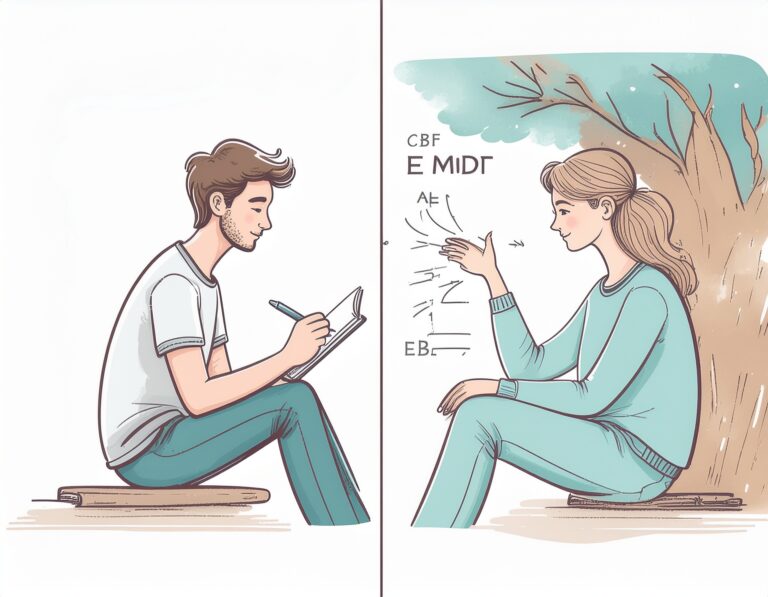
Bilateral stimulation means rhythmic, alternating stimulation of both sides of the body. In practice, this most commonly involves following your therapist’s moving hand or finger with your eyes — left, right, left, right — in sets that last roughly 20 to 30 seconds.
But eye movements are not the only option. Your therapist might use auditory tones that alternate between your left and right ears through headphones, or gentle tapping on your hands or knees. The choice depends on what feels most comfortable for you. Importantly, all three methods appear to be equally effective.
The Eight Phases of EMDR Treatment
EMDR follows a structured eight-phase approach. Here’s how it feels as a process:
- History and planning: Your therapist gets to know you and what you’d like to work on. There’s no pressure to disclose more than you’re ready to share.
- Preparation: You’ll learn about how EMDR works and practise calming techniques — including what’s called a Safe Place, a mental image you can return to if things feel overwhelming.
- Assessment: Together, you identify a specific memory to focus on, along with the negative belief attached to it (such as ‘I am powerless’) and a positive belief you’d prefer to hold (‘I am safe now’).
- Desensitisation: You hold the memory and its associated feelings in your awareness whilst engaging in bilateral stimulation. After each set, your therapist asks what comes up. You simply notice and report, without trying to analyse or direct anything. This continues until the memory no longer feels distressing.
- Installation and body scan: The positive belief is strengthened, and your therapist checks for any remaining physical tension related to the memory.
- Closure and re-evaluation: Each session ends with a return to calm, and progress is reviewed at subsequent sessions.
Processing a single memory typically takes one to three sessions. A full course of EMDR for PTSD generally involves 8 to 12 sessions, though this varies depending on the nature and complexity of what has been experienced.
What EMDR Is Not

It’s worth clearing up a few common misconceptions, because they do sometimes put people off seeking help:
- EMDR is not hypnosis. You remain fully aware and in control throughout. You can stop at any point.
- You don’t need to describe your trauma in detail. Unlike some other approaches, EMDR doesn’t require verbal accounts of what happened — something many people find deeply reassuring.
- It’s not only for PTSD. Whilst EMDR was originally developed for post-traumatic stress, the research base has expanded considerably to include anxiety, depression, phobias, grief, eating disorders, chronic pain, and more.
- It’s not a quick fix for everyone. Whilst some people notice significant changes in just a few sessions, EMDR is a structured therapeutic process — particularly for complex or long-standing difficulties.
What Does the Research Say?
EMDR has one of the strongest evidence bases of any psychological therapy for trauma. There are now more than 30 published randomised controlled trials — the gold standard in clinical research — supporting its effectiveness for PTSD in both adults and children.
Research published in the British Journal of Psychology in 2025 confirmed EMDR’s clinical effectiveness and cost-effectiveness compared to other treatments and waiting list controls. A major 2024 meta-analysis found EMDR to be equally effective as other top-tier trauma therapies, including Cognitive Processing Therapy and Prolonged Exposure Therapy.
For single-incident trauma, results can come remarkably quickly. One widely cited study found that up to 90% of single-trauma survivors no longer met the criteria for PTSD after just three 90-minute EMDR sessions. Importantly, these gains tend to be maintained — even years after treatment ends.
| At a Glance: Who Endorses EMDR? ✓ National Institute for Health and Care Excellence (NICE) — UK ✓ World Health Organization (WHO) ✓ US Department of Veterans Affairs / Department of Defense ✓ International Society for Traumatic Stress Studies (ISTSS) ✓ Australian National Health and Medical Research Council |
What Can EMDR Help With?
The strongest evidence for EMDR is in the treatment of PTSD and trauma-related difficulties. However, the research base has expanded considerably in recent years. EMDR is now used for:
- Post-traumatic stress disorder (PTSD) and complex PTSD
- Anxiety disorders, including social anxiety, generalised anxiety, and phobias
- Depression — particularly when linked to difficult past experiences
- Grief and loss
- Panic disorder
- Eating disorders with traumatic roots
- Chronic pain
- Performance anxiety
- Birth trauma and perinatal PTSD
If you’re unsure whether EMDR might be relevant to your situation, a qualified EMDR therapist can help you explore this during an initial consultation.
Is EMDR Available on the NHS?
Yes — EMDR is available on the NHS for PTSD in England, Wales, Scotland, and Northern Ireland, though access and waiting times vary significantly by area. Your GP can refer you to an NHS Talking Therapies service or a community mental health team. In some areas, you can also self-refer to NHS Talking Therapies without needing a GP referral first.
Private EMDR therapy is also widely available across the UK, with fees typically ranging from £60 to £150 per session. To find a qualified therapist, look for accreditation with EMDR UK & Ireland, the British Association for Counselling and Psychotherapy (BACP), or the UK Council for Psychotherapy (UKCP).
What Does EMDR Feel Like?
People often describe EMDR as an unusual but surprisingly manageable experience. You remain grounded in the present throughout — thinking about the past, but not reliving it in the same overwhelming way. Many people find that memories shift during sessions, becoming less vivid or emotionally charged quite quickly.
It’s also normal to feel a little tired or emotional after EMDR processing sessions, as the brain is doing significant work. Your therapist will always ensure you feel settled before a session ends, and will help you develop coping strategies you can use between appointments.
Most importantly, EMDR is always done at your pace, with your wellbeing at the centre of the work.
Is EMDR Right for Me?
If you’re carrying painful memories that keep intruding into your daily life — whether in the form of flashbacks, anxiety, low mood, physical symptoms, or a persistent sense that you can’t move on — EMDR may be worth exploring.
The best next step is to have an initial conversation with a qualified EMDR therapist. Most offer a consultation where you can ask questions, share something about your situation, and get a sense of whether the approach feels like a good fit — all before making any commitment.
EMDR is not the right approach for everyone, and a good therapist will be honest with you about that. But for many people carrying the weight of painful past experiences, it offers something genuinely valuable: a way to remember without reliving.